

| ASRock Core-100HT Intel i3-330M HTPC |
| Reviews - Featured Reviews: Notebook | Compact PC | |||||||||||||||||||||||||||||
| Written by Olin Coles | |||||||||||||||||||||||||||||
| Thursday, 01 July 2010 | |||||||||||||||||||||||||||||
ASRock Core 100HT HTPC System ReviewBenchmark Reviews has maintained a secret love affair with Home Theater PC hardware for many years, and the ASRock nettop series of compact HTPC systems continues to maintain its seductive allure. As multimedia standards are improved to handle larger bit rate formats, so does the hardware that produces them. The latest updates add SuperSpeed USB-3.0 functionality for attached storage devices, and THX TruStudio PRO technology to deliver a realistic audio experience. Other additions come in the shape of a wireless media center remote control, and uncompressed digital HDMI audio/video output. It's been one year since we last tested an ASRock HTPC: the ION 330 AMCP7A HTPC armed with the NVIDIA GeForce 9400M GPU. Now equipped with Intel's Core i3-330M 2.13GHz dual-core mobile processor and Intel GMA HD integrated graphics on an ASRock HM55-HT mini-ITX HM55-Express motherboard with 4GB of DDR3, Benchmark Reviews tests high-definition video playback and gaming performance for the ASRock Core 100HT HTPC system.
For many years I've searched for the perfect home theater PC, and every time the 'perfect' combination was within reach a critical drawback would snatch it away. My criteria wasn't very strict, but a man's home theater is a trophy onto itself. The ideal HTPC needed to allow wireless Internet access, comfortable web browsing, fast file transfers, properly display multimedia content over native uncompressed HDMI, and also play PC video games. Not a very tall order, but still no short order by any measure. So while past HTPC projects have come close, the size and functionality have continued to create limitations. ASRock combines the mobile Intel Core-i3 processor and H55-Express platform to create a system that appears to meet my requirements for the ideal HTPC. The problem has always been size and performance. High-performance notebook computers have evolved to the point where they can now replace desktop PC's, so it seems the age of large heavy-weight HTPC has come to pass. Equipped with a capable dual-core Intel Core i3-330M 2.13GHz CPU for processing power, the Core 100 series easily outpaces most other mobile/compact alternatives. Up to 4GB of 1066MHz DDR3 is supported by a 128-bit bandwidth lane from the ASRock HM55-Express motherboard. Intel's Auburndale/Arrandale Integrated Graphics Controller (IGC) is termed 'Intel HD Graphics', and resides on the Core i3-330M processor die. The full hardware acceleration of MPEG-2, VC-1, and AVC formats is perfect for streaming video content over a native HDMI 1.3a connection at high-definition 1080p (or larger) resolutions, but a small 128MB shared video memory buffer and limited OpenGL 2.1 compatibility have me concerned about 3D gaming functionality. About ASRock Inc.
ASRock Inc., established in 2002, target at entry to mainstream segment MB business, is an energetic company with the combination of technology and humanity. Devoting efforts to bring customers the innovative and reliable motherboards with the design concept of 3C, "Creative, Considerate, Cost-effective", ASRock has successfully established a well-known leading brand of the best price-performance motherboard in the industry. ASRock products' high recognition stems from company's devotion to bring the most cost-performance products to users. Besides creative features and solid products, ASRock engineers also pay special attention to EMI, thermal, acoustics and details to achieve complete customer satisfaction. In addition to price-performance, creative and considerate features, ASRock also pay special on the issue of eco-environmental protection with the release of ROHS products and energy saving functions to save the environment. To succeed in this ultra-competitive industry, ASRock provides great products with speed-to-market, cost and service to customers. Facing the constantly changing technologies of motherboard, ASRock will always keep the vision of the future and develop future-proof products upon our 3C design concept to our customers.
ASRock Core 100 FeaturesBy adopting the Intel Core i3 330M Mobile processor, Core 100HT series features Intel HD Graphics that offers great Full HD 1080p performance and energy-efficient capability. ASRock Core 100HT HTPC series conducted with Intel HM55 Express chipset supporting HDMI audio Pass-Through (Bitstream) and Dolby True HD & DTS HD Master Audio. ASRock Core 100HT series HTPC provides the compressed audio data to amplifier, and you can get the terrific sound experience. Features abundant, ASRock Core 100 HTPC series is the world's first SuperSpeed USB3.0 onboard HTPC on the market. It provides 2 x Front USB 3.0 ports that allows faster data transfer rate up to 5Gb/s. Special introduce here is THX TruStudio PRO technology. The industry leading THX TruStudio PRO technology ensures you the premium audio quality, effects and features for PC systems equipped with onboard 7.1 ch HD audio. Based on the Intel HM55 Express chipset, Core 100HT series also features Dual Channel DDR3 1066 memory, 2 x SO-DIMM slots, Max. 8GB, 2.5" HDD up to 500 GB, supports 2nd 2.5" HDD upgrade. Other excellent functions include BD Combo (Core 100HT-BD), Wi-Fi 802.11n networking as well as MCE remote controller! SuperSpeed USB-3.0 PortsWorld's first USB 3.0 HTPC system, delivers data transfer rate up to 5Gb/s and 10X faster than USB2.0 with optimized power efficiency. USB3.0 promises a major leap forward transfer speeds and capacity. Supports HDMI Audio Pass Through
ASRock Core 100 HTPC series conducted with Intel HM55 Express chipset supporting HDMI Audio Pass Through (Bitstream) and Native Dolby TrueHD & DTS-HD Master Audio. ASRock Core 100 series HTPC ensure to provide the compressed audio data to amplifier, and you can get the terrific sound experience. THX TruStudio PROTHX TruStudio PRO solution ensures you the premium audio quality, effects and features for PC systems equipped with onboard audio. For instance, the TruStudio Surround technology expands your stereo content into surround sound; the TruStudio Crystalizer technology restores the compressed sound source and can let you hear every detail in riveting surround sound. Combined with the THX TruStudio PRO and the ASRock high performance HTPC system, you will be assured to enjoy a rich variety of PRO gramming and be entertained by a better way! ASRock AIWI Rock You EverywhereKeep Moving Playing Games By Holding Your iPhone. Wanna play PC games like Wii? ASRock AIWI software makes your dreams come true! Using ASRock AIWI to connect your apple devices to the ASRock HTPC via WLAN, then you can interact with the PC games with delicate touches and body motion while getting responsive shakes and vibrations that correspond from the game stores. ASRock App ChargerFast Charge & Charge Anytime. Simply installing the App Charger driver, it makes your iPhone charge up to 40% faster than before. ASRock App Charger supports continuous charging when your PC enters into Standby mode (S1), Suspend to RAM (S3), hibernation mode (S4) or power off (S5). The App Charger technology has been fully applied on ASRock Full series motherboards. High speed Wi-Fi 802.11n (300Mbps)
ASRock Core 100 series mini HTPC, has two invisible antennas (placed in a vertical/horizontal position) hidden inside the front panel, which provide larger signal coverage and faster connection speed. With the unrestricted-direction antennas design, the HTPC can be used as the wireless network receiver, as well as the network bandwidth sharing device. Mini Size and Silent OperationWith stylish and compact design, ASRock Core 100 HTPC series has a volume of 2.5 liters only, which enables you to put inside the TV cabinet and connect it with LCD TV. Running a silent operation which is merely 25dB, Core 100 HTPC series ensures you a quiet computing environment as well. Low Power ConsumptionOur Core 100-BD system is very environmental-friendly. Our idle mode is running with only 20.1W which is different from other desktop computers which usually need 50W-80W. ASRock Core 100 HTPC series can save a lot of electricity and money each year. Ultra DurableBy adopting 100% Japan-made high-quality conductive polymer capacitors which can extend the system life to at least 2.5 longer, ASRock Core 100 HTPC series provides the stability, reliability and longevity essential to meet the power, processor, and other components needs for running today's most demanding applications and games. MCE Remote ControllerEnjoy more of your favorite entertainment by MCE (Media Center Edition) remote controller! The MCE features the entertainment center which allows you to enjoy a more convenient way of watching DVDs, TV, listening to music, and so on by the easy-operate remote controller.
Core 100HT Specifications
EDITOR'S NOTE: For a more detailed inventory of all hardware included with the ASRock Core 100HT, please see our full component report. ASRock Software Suite
CyberLink DVD Suite - OEM & Trial
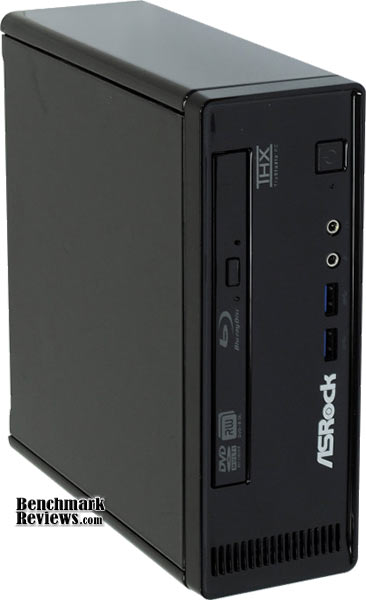
Closer Look: Asrock Core 100HTDespite its miniature size, the ASRock Core 100HT HTPC system actually contains more processing power than the majority of desktop computer systems in existance. Measuring 7.68" W x 2.76" H x 7.32" L, the mini-ITX chassis is available in either black or white gloss finish. In this review, we test the Core 100HT model that comes with a DVD multi drive, 802.11b/g/n Wi-Fi adapter, and Media Center Edition remote control. The Core 100 base model removes Wi-Fi and MCE remote, while the Core 100HT-BD model keeps them and adds Blu-ray disc functionality. All three models from the Asrock Core 100HT HTPC series come equipped with a 2.13GHz Intel Core i3-330M dual-core mobile processor and 4GB of DDR3 system memory. Notice: the ASRock Core 100HT packs an incredible amount of hardware inside a tiny mini-ITX enclosure. One look at our full hardware component report will reveal a much bigger picture, and help fill in the details for our closer look section. 
The front panel on the ASRock Core 100 HTPC offers a small vent along the left edge, while two SuperSpeed USB-3.0 ports, audio input/output jacks, and the power button are all located beneath the slimline optical drive. The front bezel is made of plastic and has a gloss finish, which will show scratches and fingerprints if handled directly.
ASRock markets the Core 100 series as a self-contained HTPC system; just add Operating System and software. On the back panel they've outfitted the Core 100HT with a native HDMI 1.3a port for HDTV connections, along with an HDMI-to-DVI adapter for digital monitors, and an D-Sub VGA connection for older analog monitors. External storage devices can be attached by the eSATA port, or one of six HiSpeed USB-2.0 ports. Digital optical audio TosLink output compliments the 5.1-channel analog audio outputs, and Gigabit Ethernet allow for network connectivity.
Removing two Phillips-head screws (not thumb screws) from the backside of the ASRock Core 100HT enclosure will allow the 'side' panel to be removed in similar fashion to tower cases. Once exposed, a drive tray assembly houses a slim-line internal SATA DVD-burner drive and 500GB Seagate Momentus 5400.6 SATA hard disk drive (unformatted). Regardless of HTPC or Nettop application, the high-capacity drive inside the ASRock Core 100HT will easily handle the storage needs demanded of it. For power users who want more performance without sacrificing capacity, the Seagate Momentus-XT Solid State Hybrid Drive is an excellent alternative. 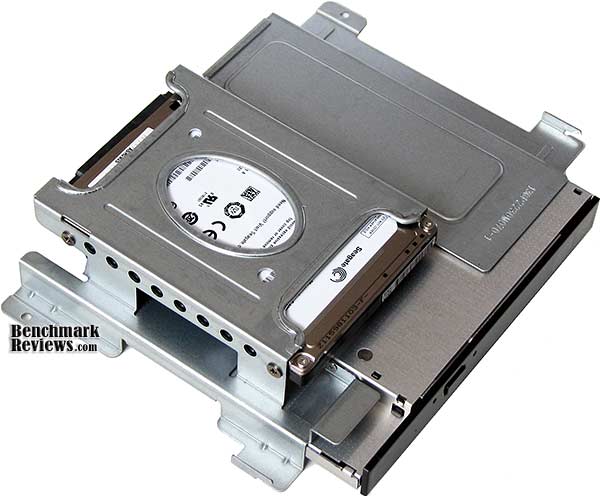
The internal drive tray pulls out away from the enclosure once two retaining screws are removed, allowing for motherboard or drive access. The HM55-HT motherboard has a third SATA and power connection add-on, should you need it, but the drive tray does not accommodate mounting. Luckily, there's just barely enough room beneath the tray for another 2.5" SATA notebook drive. In the next section, Benchmark Reviews will detail some of the more advanced features hidden in this Intel Core-i3 HTPC platform...
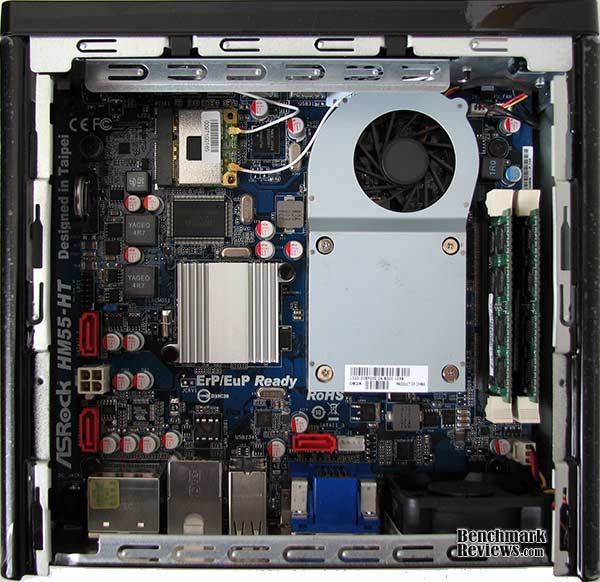
ASRock HM55-HT Detailed FeaturesWhen you task your design engineers with building on a micro-sized scale, component placement must be handled with the utmost efficiency for the system to work. ASRock has done an excellent job finding a home for everything needed to bring the HM55-HT platform to life on the mini-ITX form factor. From the overhead view illustrated below, you can see that there's very little open or available space inside the proprietary ASRock enclosure. Compared to the recently tested ASRock AMCP7A motherboard, the ASRock HM55-HT motherboard is more directly designed for HTPC purposes. The component layout is completely different, with one additional SATA port and a mini-PCI Express port that is filled with a Atheros AR9287 wireless network adapter. These two features, along with the added eSATA port, Realtek RTL8168/8111 PCI-E Gigabit Ethernet adapter, and NEC uPD720200 SuperSpeed USB-3.0 controller all add up to reasons why the Core 100 series could be the ideal all-in-one HTPC Media Center solution.
ASRock has used its experience with previous HTPC designs to assemble the most complete all-in-one kit possible with the series. All-solid capacitors prolong component lifetime and can endure harsh operating conditions, and the thick PCB is quality made. Users are still given the freedom to choose and install the Operating System that best fits their needs, whether that OS is Windows or Linux, which helps cut down on production costs. Engineers designed the ASRock HM55-HT motherboard inside the Core 100 HTPC to be completely silent. To reach this goal, unnecessary electronic components were stripped from the design and remaining hardware was orientated in-line with the enclosures front-to-rear airflow. Notice that the DDR3 DIMM modules and Intel Core i3-330M processor are positioned directly in-line with the airflow channel between a front bezel vent and the only exhaust fan inside this compact case.
The ASRock Core 100 series all feature the 2.13GHz dual-core Intel Core i3-330M mobile processor. The i3-330M includes 3MB (128KB L1 per core, 512KB L2 per core, and 3072KB shared L3) of Intel Smart Cache memory on a 32nm process, and includes Intel's 64-bit instruction set. The i3-330M maintains a 35-watt TDP, which operates separately from the 45nm Intel HD Graphics integrated 367MHz Ironlake-M GPU. The CPU processor measures 81mm2 while the GPU measures 114mm2, and both are cooled by a low-profile heatsink and silent blower fan assembly. Conversely, the mobile Intel HM55-Express chipset is cooled by a basic alloy heatsink by way of passive airflow cooling. Storage is managed by Intel's 5-series/3400 chip, and offers four SATA-3Gbps data channels. High-definition audio is available through the VIA VT2020 chip, as well as Intel's Ibex Peak PCH via HDMI.
ASRock includes two dual-channel 2GB SoDIMM modules of ASint Technology SSZ3128M8-EDJ1D DDR3-1333 (667MHz), which offer the following latency timings:
The ASRock HM55-HT motherboard supports only 1.5 volt DDR3 SoDIMM memory, so upgrades to 8GB (maximum allowed by motherboard and Intel i3 limitations) will need to maintain JEDEC standards.
One particular perk included with the ASRock Core 100HT kit is a included Windows Media Center remote control, which transmits to the integrated Microsoft eHome Infrared Transceiver on the HM55-HT motherboard. The remote is full-function, and supports all MCE functions. While some users may consider a separate remote unnecessary, since most HTPC users will undoubtedly utilize a Media Center specific keyboard such as the nMedia HTPCKB, it helps transition the PC into a fully-integrated home theater component.
Motherboard Testing MethodologyBenchmark results are only as good as their test methodology, and there are several different methods to compare product to one-another. Yet, even when you try to directly measure motherboard performance the features don't always stack up. Since processor compatibility changes across platforms, and firmware/driver updates change frequently, it's very difficult to compare motherboards in an "apples-to-apples" fashion. Still, we try. Each benchmark test program begins after a system restart, and the very first result for every test will be ignored since it often only caches the initial test. Each test is completed up to five times, with the highest and lowest scored removed. The average results of the three remaining tests are displayed in our article. Since all of the benchmarks we use for testing represent different game engine technology and graphic rendering processes, our battery of tests will provide a diverse range of results for you to gauge performance on your own computer system. Although many gamers and PC hardware enthusiasts are still using Windows XP, Benchmark Reviews has made the switch to Microsoft Windows 7 as the Operating System of choice for our test platforms. Each system compared was tested using common software and Operating System variables, however not all aspects could be matched identically. The CPU Benchmarks were collected from PCMark Vantage, EVEREST Ultimate Edition, PerformanceTest, and CINEBENCH test suites, and all used common settings for each test. PCMark Vantage features test suits with static settings, which include the TV/Movies, Gaming, and Music. PerformanceTest also conducts tests with static settings, such as the 2D and 3D graphics performance. ASRock Nettop ION 330 HTPC System
ASRock Core 100HT HTPC System
HP Pavilion DM3-1044NR Entertainment Notebook
Support Hardware
Test Software
PCMark Vantage Test ResultsPCMark Vantage is an objective hardware performance benchmark tool for PCs running 32- and 64-bit versions of Microsoft Windows Vista or Windows 7. PCMark Vantage is well suited for benchmarking any type of Microsoft Windows Vista/7 PC: from multimedia home entertainment systems and laptops, to dedicated workstations and high-end gaming rigs. Benchmark Reviews has decided to use a few select tests from the suite to demonstrate simulate real-world processor usage in this article. Our tests were conducted on 64-bit Windows 7, with results displayed in the chart below. TV and Movies Suite
Gaming Suite*
Music Suite
* EDITOR'S NOTE: Hopefully our readers will carefully consider how relative PCMark Vantage is as "real-world" benchmark, since many of the tests rely on unrelated hardware components. For example, per the FutureMark PCMark Vantage White Paper document, Gaming test #2 weighs the storage device for 100% of the test score. In fact, according to PCMark Vantage the video card only impacts 23% of the total gaming score, but the CPU represents 37% of the final score. As our tests in this article (and many others) has already proven, gaming performance has a lot more to do with the GPU than the CPU, and especially more than the hard drive or SSD (which is worth 38% of the final gaming performance score). TEST SUMMARY: Since PCMark Vantage weighs the integrated Intel HD Graphics with only 23% of the final score, the Core i3-330M processor (37% weight) and Vertex SSD (38% weight) both help pull the ASRock 100HT HTPC ahead of the 1.6GHz Intel Atom N330/ION 330 and 1.3GHz Intel Pentium SU4100/Graphics Media Accelerator 4500MHD systems. While I'm sure that the Intel Core i3-330M processor is much more powerful than the others for video and music, I'm not convinced that it will translate into a better gaming experience.
EVEREST CPU BenchmarksLavalys EVEREST Ultimate Edition is an industry leading system diagnostics and benchmarking solution for enthusiasts PC users, based on the award-winning EVEREST Technology. During system optimizations and tweaking it provides essential system and overclock information, advanced hardware monitoring and diagnostics capabilities to check the effects of the applied settings. CPU, FPU and memory benchmarks are available to measure the actual system performance and compare it to previous states or other systems. Furthermore, complete software, operating system and security information makes EVEREST Ultimate Edition a comprehensive system diagnostics tool that offers a total of 100 pages of information about your PC. All of the benchmarks used in our test bed: Queen, Photoworxx, ZLib, and AES, all rely on basic x86 instructions, and consume very low system memory while also being aware of HyperThreading, multi-processors, and multi-core processors. While the EVEREST CPU tests really only compare the processor performance more than it measures platforms, it still offers a glimpse into what kind of power each platform possesses.
Queen and Photoworxx tests are synthetic benchmarks that operate the function many times over and over-exaggerate by several magnitudes what the real-world performance would be like. The Queen benchmark focuses on the branch prediction capabilities and misprediction penalties of the CPU. It does this by finding possible solutions to the classic queen problem on a chessboard. At the same clock speed theoretically the processor with the shorter pipeline and smaller misprediction penalties will attain higher benchmark scores. Like the Queen benchmark, the Photoworxx tests for penalties against pipeline architecture. The synthetic Photoworxx benchmark stresses the integer arithmetic and multiplication execution units of the CPU and also the memory subsystem. Due to the fact that this test performs high memory read/write traffic, it cannot effectively scale in situations where more than two processing threads are used. The EVEREST Photoworxx benchmark performs the following tasks on a very large RGB image:
The Zip Library test measures combined CPU and memory subsystem performance through the public ZLib compression library. ZLib is designed as a free lossless data compression library for use on virtually any computer hardware and operating system. The ZLib data format is itself portable across platforms and has a footprint independent of input data that can be reduced at some cost in compression. The AES integer benchmark measures CPU performance using AES data encryption. It utilizes Vincent Rijmen, Antoon Bosselaers and Paulo Barreto's public domain C code in ECB mode and consumes 48 MB of memory. TEST SUMMARY: Everest does an excellent job of illustrating the processing superiority delivered by Intel's Core i3-330M CPU over some of the other processors packaged and sold inside 'home theater' -themed PCs. While not all of these CPU tests are going to apply to multimedia entertainment, they give a good reference to the differences in processing power. As expected, the ASRock Core 100HT HTPC tops the charts here with its desktop-inspired Intel Core i3-330M processor.
Passmark PerformanceTestPassMark PerformanceTest is a PC hardware benchmark utility that allows a user to quickly assess the performance of their computer and compare it to a number of standard 'baseline' computer systems. The Passmark PerformanceTest CPU tests all benchmark the mathematical operations, compression, encryption, SSE, and 3DNow! instructions of modern processors. In our tests there were several area's of concentration for each benchmark, which are combined into one compound score. This score is referred to as the CPU Mark, and is a composite of the following tests:
Taken together as a whole, the eight separate CPU tests offers a very realistic segment of what taxes the processor most for users. These tests are grossly exaggerated synthetic benchmarks, but they can still help illustrate the difference between similar hardware. TEST SUMMARY: Collectively speaking, Passmark PerformanceTest simply reinforces the scores we previously explained in the EVEREST test results section. The dual-core 1.6GHz Atom 330 (ASRock ION 330) and 1.3GHz Intel Pentium SU4100 (HP Pavilion DM3-1044NR) try their best, but don't stand up to Intel's latest Core i3-330M processor series in the CPU tests. While 2D graphics relies heavily on processing power, and therefore relegates the higher-performing CPUs to lead the charts, 3D Graphics testing was different. Dependent on GPU power, both integrated Intel GPUs failed one of the test in the 3D Graphics benchmark, stating 'video card must support at least 4x anti-aliasing'. Despite having a reduced score, the ASRock Core 100HT HTPC and HP Pavilion DM3-1044NR notebook both still outperform the NVIDIA ION graphics processor.
Cinebench R11.5 BenchmarksMaxon Cinebench is a real-world test suite that assesses the computer's performance capabilities. Cinebench is based on Maxon's award-winning animation software, Cinema 4D, which is used extensively by studios and production houses worldwide for 3D content creation. Maxon software has been used in blockbuster movies such as Spider-Man, Star Wars, The Chronicles of Narnia and many more. Cinebench Release 11.5 includes the ability to more accurately test the industry's latest hardware, including systems with up to 64 processor threads and the testing environment better reflects the expectations of today's production demands. A more streamlined interface makes testing systems and reading results incredibly straightforward. The Cinebench R11.5 test scenario uses all of a system's processing power to render a photorealistic 3D scene, "No Keyframes" the viral animation by AixSponza Motion Design. This scene makes use of various algorithms to stress all available processor cores. The OpenGL graphics card testing procedure uses a complex 3D scene depicting a car chase with which the performance of your graphics card in OpenGL mode is measured. During the benchmark tests the graphics card is evaluated by way of displaying an intricate scene that includes complex geometry, high-resolution textures, and a variety of effects to evaluate the performance across a variety of real-world scenarios. The OpenGL tests in Cinebench force processor-first graphics computation before offloading work to the available video card. Cinebench R11.5 reveals performance results illustrated in the chart below:
Cinebench R11.5 Processor Benchmark ResultsTEST SUMMARY: Cinebench does an good job of translating CPU processing power into graphics power, and illustrating the differences between components. The dual-core 1.6GHz Atom 330 (ASRock ION 330) and 1.3GHz Intel Pentium SU4100 (HP Pavilion DM3-1044NR) appear to function similarly in the CPU Multi-Core benchmark test, but the Intel Core i3-330M (ASRock Core 100HT) obliterates them both with 137~240% boost in performance over the competition. The unfortunate news here is that the Cinebench OpenGL tests failed on the Graphics Media Accelerator 4500MHD (HP Pavilion DM3-1044NR), but there were still two results to compare. The ASRock ION 330 scored 4.67, beating the ASRock Core 100HT's Intel GMA HD score of 1.17 by nearly 300%. This reverses results in PCMark Vantage, and creates even more doubt that the ASRock Core 100HT HTPC can handle 3D gaming... but the next few tests will settle this point.
Street Fighter IV BenchmarkCapcom's Street Fighter IV is part of the now-famous Street Fighter series that began in 1987. The 2D Street Fighter II was one of the most popular fighting games of the 1990s, and now gets a 3D face-lift to become Street Fighter 4. The Street Fighter 4 benchmark utility was released as a novel way to test your system's ability to run the game. It uses a few dressed-up fight scenes where combatants fight against each other using various martial arts disciplines. Feet, fists and magic fill the screen with a flurry of activity. Due to the rapid pace, varied lighting and the use of music this is one of the more enjoyable benchmarks. Street Fighter IV uses a proprietary Capcom SF4 game engine, which is enhanced over previous versions of the game. While modern desktop computers with discrete graphics have no problem playing Street Fighter IV at its highest graphical settings, integrated and mobile GPUs have a difficult time producing playable frame rates with the lowest settings configured.
TEST SUMMARY: In terms of 3D graphical demand, Street Fighter IV is considered very low-end for most desktop GPUs. However, mobile graphics processors haven't quite caught up with discrete video cards, and the strain is evident. Configured to 1280x720 (720p) with anti-aliasing and anisotropic filtering disabled, only the NVIDIA GeForce 9400 GPU GPU inside the ASRock ION-330 HTPC could produce decent frame rates. The ION 330 delivered 22.4 FPS on average, compared to 18.2 FPS on the ASRock Core 100HT, and only 8.7 FPS with the 1.3GHz Intel Pentium SU4100/Intel Graphics Media Accelerator 4500MHD. Based on all of the tests conducted up to this point, I can surmise that synthetic graphics performance is not at all representative to real-world 3D gaming performance with the Core i3/Intel GMA HD graphics processor... especially when Street Fighter IV is involved.
Lightweight Gaming PerformanceWhile most readers will understand that comparing integrated video on the ASRock Core 100HT HTPC to any NVIDIA GeForce or ATI Radeon add-in graphics solution would be unfair, and at the same time it's also unfair to match the integrated Intel HD Graphics chip to NVIDIA's GeForce 9400 GPU on the ION platform. While discrete graphics have the advantage of large memory buffers and powerful dedicated graphics processors, they can never fit inside the micro-size package an integrated or mobile GPU can. So what kind of games can the mobile GPUs play? Benchmark Reviews has tested frame rate performance using several video games displayed at 720p (0.92 MP) and 1080p (2.07 MP) HDTV resolutions, and the ASRock Core 100HT HTPC platform proved itself capable of every streaming video and 2D application we threw at it. While playing 3D games the results were considerably different, even with relatively low-demand titles such as Team Fortress 2, World of Warcraft, or Fallout 3. These games were not very enjoyable when played on a 1080p HDTV, even with all of the settings turned down. At 720p (1280x720) the performance perked up, and frame rates made the video action more fluid. Perhaps I was being unrealistic, and expecting that people would actually pass-up their gaming console or PC just to play these games on an HTPC in the first place. After all, this still amounts to comparing integrated graphics against add-in video cards. 
Since most intense action and first-person shooter games are best experienced on high-resolution monitors and not HDTV resolutions, I decided to change my format and play some of the more entertaining titles that depend less on graphics power. The first was Battlefield Heroes, an online-only first-person shooter that requires very little graphic processing but still offers outstanding game play and hours of fun. Comparing the desktop gaming experience of playing Battlefield Heroes on high-resolution monitors (1680x1050 or 1920x1200) against the integrated Core i3 GPU experience on my 1080p HDTV actually offered no perceivable difference, which is exactly what desktop graphics should begin to fear. When it came to games like Spore, The Sims, or parlor games such as Mahjong, Bejeweled 2, Solitaire, online Poker, or puzzles, the integrated Intel HD Graphics will work just fine. It's not uncommon for someone to play these games on a desktop computer, but it's much more comfortable to relax on a couch or recliner and take it all in with your feet up. The Intel Core i3-330's HD graphics chip certainly doesn't threaten gaming consoles since they've got advanced graphics processors and a proprietary format, but then again consoles don't have WoW, Spore, or The Sims to their credit. The bottom line is that integrated graphics on ASRock's Core 100HT system will handle all the streaming video content you can ask of it, but desktop-level graphics detail is reserved for 2D and entry-level 3D titles.
ASRock HTPC Final ThoughtsComputers are at a constant struggle with scaled performance, and the PC is ground zero for innovation. CPU's and GPU's have both become much smaller, while fitting many more transistors into them. The opposite is true for their total package size, as evidenced by the growing dimensions for heatsinks and printed circuit boards. These things directly relate to HTPCs, primarily because personal entertainment enthusiasts demand oversized performance inside of undersized enclosures. While CPUs have scaled accordingly, as has storage media with the SSD, it seems that GPUs are still clinging to the outdated 'bigger is better' philosophy. Intel and AMD each offer dual-core mobile processors, and they offer excellent performance with very low power consumption demands. Seagate offers a 500GB Solid State Hybrid Drive that outperforms some of the fastest desktop hard drives while remaining notebook-sized. SoDIMM-sized system memory has made 4GB RAM modules available to compact computers, breaking a barrier that has held notebook computers back for years. Even motherboards have shrunk to miniature proportions, such as the micro-ITX form factor seen with the ASRock HM55-HT. The only remaining holdout is the graphics processor.
Integrated graphics can display HD content at 1280x720 for 720p resolution on your HDTV, or even 1920×1080 for 1080p, but the situation changes when 3D video games are added into the equation. Based on the performance results we've received thus far, it seems that powerful 3D gaming performance isn't coming to compact HTPCs anytime soon. Benchmark Reviews has already proven that almost any discrete video card on the desktop graphics market will play our favorite games with acceptable settings and frame rate performance, but more than halfway through 2010 consumers still can't get the same performance for mobile/compact computer platforms. While I'm sure someone has found a level of satisfaction in playing video games on their tiny netbook PC at 1024x600 resolution, it's simply unrealistic to expect that same gaming experience to equal desktop PCs or gaming consoles. Ultimately, only the most lightweight video game titles are playable with integrated/mobile GPUs. While there are a few exceptional GPUs out there that have been 'made mobile', but none of these are economical or operate in a low-power envelope, and none of them are going to be your cheap ticket to replacing desktop-level graphics performance with demanding 3D video games. Intel has yet to produce any GPU capable of powerful 3D gaming, as the Intel HD Graphics inside ASRock's Core 100HT HTPC has demonstrated. Unfortunately, graphically powerful GPUs with low-consumption and low-TDP aren't available from NVIDIA or ATI either. Have they read the writing on the wall? The desktop computing segment shrinks by the day, ever woefully losing market segment to compact computing devices. It's not my place to tell someone how to run their business, but one would think that selling leaded fuel in the hydrogen age would be a losing proposition. Intel has conceded defeat to NVIDIA in the GPU industry and has returned to doing what they've always done best. Perhaps it's time for ATI to focus itself on the mobile graphics market, just as AMD has remained focused on the value-processor segment. Doing things incrementally better each time is not nearly as important as doing things that the industry needs.
|
|||||||||||||||||||||||||||||





Comments
On the other hand AsRock needs to have their heads examined... the intel 4500hd video chip...wtf.... you cant do hd decoding with that without crushing the cpu ...
Go back and use a nvidia chipset and watch it pur like a kitten thru Ll the hd content you have.
As for HD quality and CPU overhead, they were difficult to demonstrate because each media changed the outcome. DVDs were clean and lossless, MKV and flash each performed extremely well but had different CPU usuage depending on the source. Overall I didn't have any problems with HD media playback.
Encoding was not tested, aside from the included encoding tests that PCMark and Passmark perform.
This is an Intel restriction, and a quite anti-competitive one at that.
Just look at the score at hwbot.org 3000 3dmark06:
#hwbot.org/hardware/videocard/gma_hd?tab=rankings#/manufacturer.rankings.do?applicationId=12&manufacturer=intel&hardwareTypeId=GPU_1645&hardwareType=GPU&tabid=gpubenchmarks
compared to ion 1.9k:
#hwbot.org/hardware/videocard/nvidia_ion?tab=rankings#/manufacturer.rankings.do?applicationId=12&manufacturer=nvidia&hardwareTypeId=GPU_1530&hardwareType=GPU&tabid=gpubenchmarks
hmmmm......didn't quite make that
Thanks in advance!!
Yes, you can easily play back 1080p video with this and stream via HDMI for full DTS sound. I might suggest something that could play games, too:
/index.php?option=com_content&task=view&id=620
What are the main diferences between this and the Vision 3D?