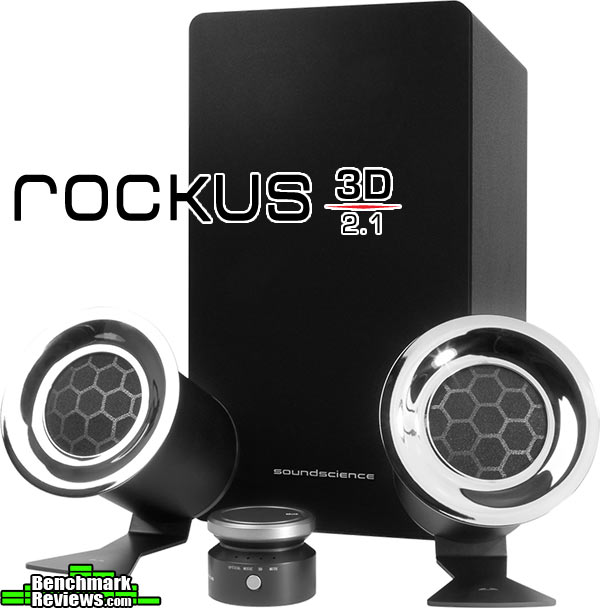

| Antec SoundScience Rockus 3D Speaker System |
| Reviews - Featured Reviews: Audio | |||||||||||||||||||||||||||||||||||||||||||||||||||||||
| Written by Olin Coles | |||||||||||||||||||||||||||||||||||||||||||||||||||||||
| Saturday, 26 February 2011 | |||||||||||||||||||||||||||||||||||||||||||||||||||||||
Antec soundscience rockus 3D Speaker System
Product Name: rockus 3D Speaker System Full Disclosure: The product sample used in this article has been provided by Antec. Antec has dominated the computer chassis market for more than a decade, and with many of their customers slowly converting to portable platforms it makes good business sense to diversify the product portfolio. Enter soundscience, a subsidiary of Antec, that is dedicated to audiophile-level products for use on multiple platforms. The soundscience rockus 2.1 speaker system features 3Dsst sound technology, which makes use of 3D-audio optimized solid aluminum satellite drivers and an active subwoofer with passive radiator to create an extended low frequency response. In this article, Benchmark Reviews tests the Antec soundscience rockus 3D speaker system against the Logitech Speaker System Z623 and see how well it works for gaming consoles. Of all the competitive market segments within the computer hardware industry, audio products are one of the most rarefied. Most component manufacturers hit a ceiling when they design multimedia speaker systems, and the barrier is usually product price. It's difficult to market a single-purpose computer speaker system for a premium price tag, especially in an age when earbuds and MP3 music are the standard. So it takes a little vision to overcome these limitations, and design an audio system that works on many platforms, including home theater. This was the approach Antec has taken with their all-lower case soundscience brand, enabling the rockus 3D speaker system to function equally well for PC, gaming console, and home theater equipment. Long before computers were a part of my life, I was an audio enthusiast. Living near Tokyo (Japan) afforded me the opportunity to experience the best equipment and audio components any audiophile could ask for. Unfortunately, very few consumers appreciate quality sound reproduction, and will often settle for anything that makes noise. In this article, I will share some of my insights with you and investigate the soundscience rockus 3D speaker system. This isn't a review for the uninitiated, because unless you're familiar with band-pass filters or active/passive driver systems, some of the audio terminology could be confusing. I'll do my best to keep you up to speed...
What sets the rockus 3D system apart is it's unique features. There are three primary features that the soundscience rockus 3D speaker system offers:
rockus 3D FeaturesThe rockus 3D | 2.1 speaker system creates a personal home theater experience that brings the power and realism of 3D audio together with the clarity and accuracy of high-fidelity music. 3Dsst, soundscience's 3D technology, actively analyzes incoming stereo audio signals and intelligently places them into a 3D sound field. The results are a personal theater experience with realistic, immersive 3D sound for your movies and games from 2.1 speakers - whether it's the impact of an explosion, the snap of a baseball whizzing by a player's face, or the thunder and fury of a videogame gunfight. The rockus also features a dedicated music mode optimized for superb stereo sound reproduction, letting you hear your music with deep, visceral sub-bass and spacious crisp, mids and highs. soundscience puts 3D cinematic sound and high-fidelity music in its place: Your room.
rockus 3D Specifications
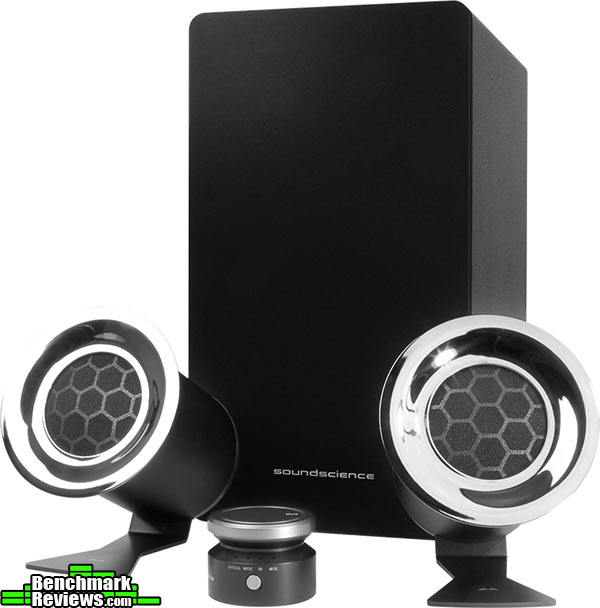
Features and specifications provided by Antec, Inc. Closer Look: soundscience rockus 3DThe Antec soundscience rockus 3D sells for $250 at Amazon, Newegg, or PriceGrabber, which puts this speaker system among the highest-priced audio components available to PC enthusiasts. Fortunately, the rockus 3D system offers more than just computer audio, which we'll detail in this article. For your money, you get two satellite speakers, a powered subwoofer, the remote control pod, and several analog speaker cables with wire.
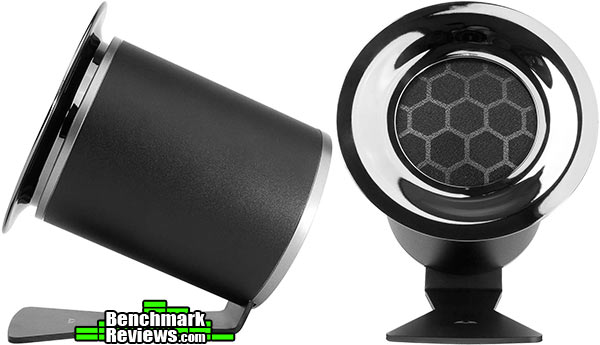
The soundscience rockus 3D satellite speakers offer 25W power each, and deliver 95dB SPL (sound pressure level) maximum output. Each satellite speaker measures 5.7" H x 4.7" W x 6.3" D (144.8 mm H x 119.4 mm W x 160 mm D) and weighs approximately 1.5 pounds. Antec specifies the frequency response between 10Hz and 20kHz, which seems to combine the subwoofer and satellite speakers into one interesting figure. Each speaker receives a pair of RCA inputs, which use the included speaker cable to connect into the subwoofer.
Antec uses solid anodized aluminum barrels for the satellite speaker enclosure, which translates into an extremely powerful focused reverberation/firing effect that reduces distortion and delivers true frequency response from the drivers. In each satellite speaker, a 2.75" driver is positioned behind a soft grill and metal mesh. Based on its size, the satellite seems very capable of reaching 20kHz high frequencies.
The subwoofer unit that ships with the Antec soundscience rockus 3D is rather unique among multimedia speaker systems. An active 6" driver is paired to a 6x9" passive radiator (cone without voice coil and magnet), and effectively creates two low-frequency bass tones in separate directions. The 6x9" cone fires forward, while the active 6" driver fires towards the rear of the box. Lacking a direct volume-control know, there's a three-position bass output switch. The only thing that's missing from this subwoofer system is a professionally tuned band-pass enclosure! soundscience rockus Detailed FeaturesThe rockus 3D remote control pod allows for full system management, allowing users to adjust or mute the volume and enable 3D mode on the fly. According to Antec, the trademarked soundscience rockus 3D audio technology "is a suite of DSP (digital sound processing) algorithms that creates a virtual surround sound experience from 2.1 stereo speakers". 3Dsst technology actively analyzes incoming digital stereo audio signals and intelligently places them into a 3D sound field on a 2.1 speaker system. The soundscience rockus also boasts a dedicated music mode optimized for organic stereo sound reproduction, enabling users to hear music with deep sub-bass tones with powerful mids and crisp highs.
While the anodized aluminum-enclosed satellite speakers do their part, it's really the low-frequency bass tones from the active/passive subwoofer system that get it done. Many audio enthusiasts are unaware of how sound waves travel, and the physical properties of high and low frequency sound. High-frequency sound waves travel only a short distance and are easily blocked, which is why tweeters (high) and mid-range drivers require direct-firing placement with the audience in order to be effective. Long low-frequency sound waves will travel much longer distances, and can pass through porous materials. This means that you don't have to point your subwoofer in the direction of the audience, and doing so actually weakens it's impact.
The designers at Antec are aware of this, and place the passive radiator to the front of their subwoofer case while the 6" driver fires out the back... quite presumably at a wall. This benefits the effects of low-frequency sound, since humans have a difficult time hearing these waves but can easily feel them in surrounding materials (the floor, furniture, walls, etc). By firing out from both sides, there's a greater opportunity to transfer low-frequency sound waves into material that will translate the energy into something the audience can feel. If you're really after impressive low-frequency bass, position the sub-woofer in a corner at a 45° angle so that both openings face the nearby walls.
The soundscience rockus kit contains three different sets of cables, each of them featuring gold-plated connection ends. The system includes a remote 'Top Controller' pod cable, two RCA to open-end speaker cables for connecting the satellites to the powered subwoofer, an auxiliary audio 3.5mm to 3.5mm cable for connecting portable stereo devices to the system, and a RCA to 3.5 mm cable for connecting to an Audio/Video receiver. What's missing in this premium package is an RCA-to-RCA cable for higher-quality AV receiver connections, and an optical audio TosLink cable for high-end sound cards, HDTVs, receivers, and gaming consoles. I've been harping on the absence of TosLink cables with high-end sound cards for quite some time, and it seems that Antec could fill this basic user need by including one in future packages. Speaker System Test ResultsTesting speakers can be done two ways: the right way, using an anechoic chamber with calibrated audio equipment, or the layman's method using a subjective ear and unqualified hardware. This section is closer to the latter, and I apologize for that in advance because this website is named Benchmark Reviews after all. Perhaps manufacturers will recognize my understanding of the subject matter, and offer to put their reputation on the line with quantitative results that back their claims. This would make it worthwhile to spend money on test equipment, but if the product isn't as good as they claim it may not be in their best interests. Here's my subjective analysis: For this project I tested the Antec soundscience rockus 3D speaker system against three others: Logitech's Z623 premium THX-certified 2.1 speaker system, a 2.1-channel Logitech X530 system, and a much older Logitech Z340 sound system. All four of these speaker systems are computer-compatible 2.1-channel kits, but only the rockus 3D and Logitech Z623 demand premium-level prices. While the Logitech X530 and Z340 kits are decent multimedia speaker systems, they are not capable of high-level audio quality that the rockus 3D and Logitech Z623 produce. Here is where it becomes a listener's market, because none of these offer a dedicated center channel and lack 5.1 or 7.1-channel separation. More than anything, it really depends on what you plan to use them for. Perhaps this is where the rockus 3D comes to shine in comparison to others, because 3Dsst technology manipulates the digital sound processing signals to create that illusive center field of sound. The 3D mode helped create a natural ambiance in music playback, and movies were generally very pleasing with or without this feature. Video games weren't effected enough for me to tell the difference, but it was hard to tell which direction attacks were coming from. The sound levels were crisp and clear at their respective low, mid, and high-level tones, but they don't compete with enthusiast-level six or eight-piece speaker systems designed for much larger environments. However, for space-constrained users looking for an upscale sound system that can simultaneously connect their gaming console (via TosLink in PCM mode), HDTV (via RCA), and notebook/desktop PC (via aux 3.5mm audio jacks), the rockus 3D offers a lot of value. If you're after deep base, the Antec soundscience rockus 3D speaker system truly delivers. I am unable to confirm the 10Hz low-frequency specification, but with the combined active/passive system it's certainly possible. By following my suggestions in the previous section, audio enthusiasts could easily fool listeners into thinking that the powered subwoofer is delivering a lot more than 100W of bass.
soundscience rockus 3D ConclusionIMPORTANT: Although the rating and final score mentioned in this conclusion are made to be as objective as possible, please be advised that every author perceives these factors differently at various points in time. While we each do our best to ensure that all aspects of the product are considered, there are often times unforeseen market conditions and manufacturer changes which occur after publication that could render our rating obsolete. Please do not base any purchase solely on our conclusion, as it represents our product rating specifically for the product tested which may differ from future versions. Benchmark Reviews begins our conclusion with a short summary for each of the areas that we rate. In terms of product performance, the rockus 3D speaker system did well overall but the absence of a physical center channel is holding it back. I know it's uncustomary, but if positioned correctly a 3.1-channel speaker system could essentially mimic a 5.1-channel kit. In the end, Antec's 3Dsst technology is an acceptable alternative, but two 25W drivers don't make up for a missing speaker. It's worth noting that the soundscience rockus system isn't designed with THX, DTS, AC3, or any other standard in mind; but when it comes to 2.1-channel sound quality the soundscience rockus 3D speaker system has very few competitors. The bass tones are unbelievably tight, and for a 100W 6" driver you'd be surprised how low it can go. Generally speaking, manufacturers go out of their way to convince consumers that their audio products sound as good as they look. Antec is no different, and the soundscience rockus 3D kit is given a polished show-quality shine to chrome-plated plastic bezel pieces on black satellite speakers; even the remote pod looks sharp! On the other hand, Antec could have done something to differentiate their subwoofer from everything else that's appeared on the market since 1931. It might cost them a little more to produce, but if the soundscience rockus 3d subwoofer had used a thick oval-shaped plastic housing that featured soft angles, consumers would jump on this like they did the iPod a few years back. Antec put quality first with the rockus 3D speaker system, and the solid anodized aluminum barrel chambers are a testament to its durable construction. These aluminum chambers lend themselves to improving functionality, but not nearly to the same extend that an active 6" subwoofer paired to 6x9" radiator does for bass levels. Users with a grasp on audio technology will use this multi-firing subwoofer to reproduce the bass impact of much larger speakers, such as a single-firing 10" subwoofer. As of March 2011, the Antec soundscience rockus 3D speaker system sells for $250 at Amazon, Newegg, or PriceGrabber. For a 2.1-channel speaker system this is priced rather high, and may cause consumers to overlook the strongest aspect of this kit (hint: subwoofer). The rockus 3D kit is perfect for dorm rooms and apartments, and connects to a gaming console, television, or computer where the competition cannot. If Antec can market these speakers to the right audience, the value becomes apparent. But when you've got 5.1-channel multimedia speaker systems selling for half the price, consumers begin to lose sight and choose quantity over quality. Pros:
|
|||||||||||||||||||||||||||||||||||||||||||||||||||||||